

.png)
FHWA Signals Potential Shift to 100% Domestic Content for Federally Funded EV Chargers
Published: 2.20.2026
.png)
Key Takeaways
- FHWA is considering raising EV charger domestic content requirements from 55% to up to 100% for Federal-aid highway projects.
- The proposal applies to chargers funded under programs such as the NEVI Formula Program, created under the Bipartisan Infrastructure Law.
- Public comments are open through March 16, 2026, before FHWA determines whether to continue, modify, or discontinue the existing waiver.
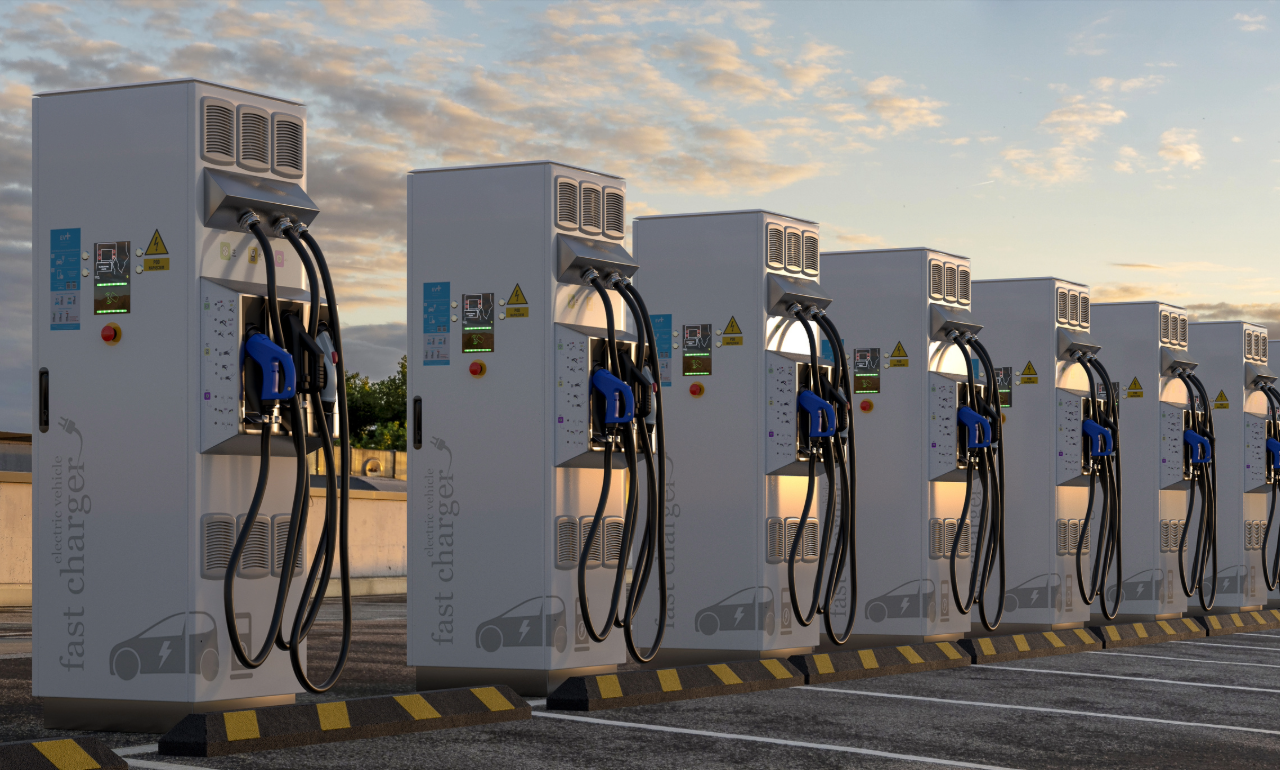
On February 12, 2026, FHWA published a formal Notice; request for comments asking whether it should tighten its existing FHWA Buy America waiver for electric vehicle chargers. Specifically, the agency is considering increasing the domestic content threshold from 55 percent to as much as 100 percent of the cost of all components for chargers used in Federal-aid highway projects.
The proposal marks a potentially significant shift in the federal government’s EV infrastructure policy. While the current rule requires final assembly in the United States and more than 55 percent domestic component cost for chargers manufactured after July 1, 2024, FHWA is now openly asking whether the market is ready for a higher bar.
The Architecture of Compliance
FHWA’s framework hinges on a cost-based calculation and domestic content is not measured by counting parts but by the cost of components incorporated into the charger. A charger can contain hundreds of sub-elements, but compliance depends on whether the components are manufactured in the United States and how their cost share contributes to the overall total.
That distinction matters because a modern fast charger may include hundreds of elements, but only a handful of categories drive most of the value: the power-conversion stage, control electronics, communications, metering, and thermal management. If even one of those high-value pieces remains non-domestic, it can swing the entire cost-share calculation.
FHWA also draws a hard line between “components” and “subcomponents.” A component is the material directly incorporated into the end product at which the domestic-content math is applied.
In addition, if a charger housing or enclosure is predominantly iron or steel, that structure falls outside the EV charger waiver and must independently comply with FHWA’s longstanding iron and steel Buy America requirements. These layered definitions make documentation and cost transparency central to compliance strategy.
Why there was a waiver in the first place
To understand why FHWA is even debating this now, you have to go back to the 2023 policy design.
FHWA’s February 21, 2023 waiver was framed as a bridge to let charger deployment proceed immediately while U.S. manufacturing scales, then phase in stricter domestic-content requirements over time.
FHWA’s guidance spells out how that phase-in worked:
- For chargers manufactured on/after March 23, 2023 and before July 1, 2024, where installation began by October 1, 2024 the key requirement was final assembly in the United States.
- Starting July 1, 2024 chargers had to undergo U.S. final assembly and exceed 55% domestic component cost.
Now FHWA is asking whether that 55% “step” should be raised potentially all the way to “up to 100%.”
This proposal lands in a moment when federal EV charging programs tied to Federal-aid highway funding are still moving from planning into scaled execution.
DOT’s public messaging frames a stricter approach as an industrial policy lever to strengthen domestic manufacturing, create jobs, improve competitiveness, and reduce supply-chain dependency for critical infrastructure.
But industry pushback has focused on the practical reality that charger supply chains are global, and the hardest-to-localize elements often live inside the enclosure. News coverage and stakeholder statements have warned that a rapid move toward a 100% threshold could slow deployments or raise costs, especially if compliance changes faster than qualification and manufacturing footprints can adapt.
The Supply Chain Tension
High-power EV chargers rely on advanced power electronics such as IGBTs, SiC modules, controller boards, communications modules, metering interfaces, and thermal management systems. While U.S. manufacturing capacity has expanded in some segments, global supply chains continue to dominate key semiconductor and high-efficiency power module markets.
If FHWA ultimately raises the threshold toward 100 percent, manufacturers will need to evaluate which components qualify as “manufactured in the United States” under the rule’s definitions, which high-value assemblies drive the cost-share calculation, and how quickly alternative domestic sourcing or production pathways can be validated without introducing reliability or certification risk.
Because compliance hinges on cost concentration rather than part count, the pressure will fall disproportionately on high-value electronics and power stages. Even before a final decision is issued, the proposal is likely to accelerate scenario planning around dual sourcing, domestic manufacturing partnerships, and enhanced country-of-origin documentation.
Industry responses have already begun to surface. Advocacy groups have cautioned that a fully domestic requirement, if implemented abruptly, could slow charger deployment or increase costs for states racing to meet NEVI corridor deadlines. Others argue that predictable, escalating standards provide the certainty manufacturers need to justify capital investment in U.S.-based production.
Public comments on the proposal remain open through March 16, 2026. After reviewing stakeholder feedback, FHWA will decide whether to maintain, modify, or discontinue the existing waiver structure.


